Bringing a young dog into your life is joyful, but the first period can feel uncertain. Expect swings in behavior: some pets seem shut down, others act over the top. The Rule of 3’s — 3 days, 3 weeks, 3 months — helps set calm expectations during the transition.
Why are dogs unsettled? Leaving littermates and familiar smells can make a puppy scared and confused. That stress shows as hiding, escape attempts, refusal to eat, GI upset, or potty accidents.
This guide previews a step-by-step approach: pre-arrival setup, a first-hour plan, a first-week routine, gradual space expansion, and gentle training from day one. We focus on predictability — consistent feeding, cues, and locations — to reduce anxiety and speed trust.
Safety comes first. You will learn positive reinforcement and management tools like gates, supervision, and toy rotation. For practical arrival tips, see how to bring your new dog.
Prep Your Home for a Calm Transition Before Your New Puppy Arrives
Create a compact, puppy-proof space to limit stimulation and help confidence grow slowly. A small starter zone keeps the animal from feeling overwhelmed by the entire house.
Create a puppy-proofed space to prevent sensory overload
Use gates and closed doors to limit the area. Secure cords, pick up small items, block stairs, and remove toxic plants or chemicals from reach. This reduces sudden surprises that can spike anxiety.
Set up a safe sleep spot with a crate or bed that feels like a “den”
Place a crate or cozy bed in a quiet corner with familiar bedding. Introduce the crate as a comfort zone using calm, treat-based associations so it becomes a restful den—not punishment.
Choose a consistent area for food and water bowls
Pick one spot for food and water bowls and keep it steady. Predictable locations help the animal learn where to find resources and support early training of routines.
Stock safe chew toys, plus interactive toys and puzzle feeders
Provide multiple safe toys and at least one puzzle feeder to occupy curious minds and redirect chewing away from household things.
Plan for schedule and sound changes to reduce anxiety in a new environment
Map a clear routine from day one: meals, potty, play, and rest. Play gentle neighborhood or city soundtracks at low volume to build tolerance. Consider pheromone support like Thunderease® and discuss options with your vet.
For arrival checklists and more practical guidance, see bringing your new dog.
The First Hour in Your New Home: How to Bring Your Puppy Inside Without Overwhelming Them
The first sixty minutes should focus on simple wins—an outdoor potty, a quiet room, and measured greetings.
Start at the chosen potty place. Take the dog outside right away. Wait quietly for elimination. If they go, use a consistent cue such as “go potty” and give calm praise. This begins house-training and reduces confusion.
Bring the dog indoors into the prepared starter area. Keep voices low and excitement minimal. Allow gentle exploration of that single room only. Close off other rooms to avoid overstimulation and accidental chewing or ingestion.
Slow room-by-room introductions
Open one room at a time while you follow closely. Watch for marking or frantic sniffing and step in to redirect to a toy or the crate. Supervision prevents accidents and lowers stress-driven roaming.
Meeting people and family members
Have family members greet the newcomer one at a time. Let the dog approach, sniff, and step back. Offer gentle petting only when the dog seeks contact. Avoid loud greetings that can spike fearful or hyperactive behavior.
- Quiet potty first — cue and praise.
- Starter room — limit to one place for the first hour.
- Slow intros — one person or family member at a time.
- Watch signals — panting, freezing, hiding, frantic sniffing.
| Checklist Item | Action | Why it helps |
|---|---|---|
| Potty cue | Take outside, say cue, praise | Starts consistent training and reduces accidents |
| Starter area | Lead into one prepared room | Limits sensory load and prevents wandering |
| Supervised exploration | Open rooms slowly, follow closely | Prevents chewing and ingestion |
| Family intros | One person at a time, calm | Builds trust and reduces stress reactions |
If you notice stress signs in the first hour, simplify the scene. Return to the starter place, offer a quiet toy, and give a short rest. These steps support a smooth transition into the larger environment over the first week and beyond.
Set Up a Daily Routine That Builds Security in a New House
Set a simple daily rhythm that helps your dog know what to expect each day. Predictability reduces anxiety and makes training easier.
Keep feeding, potty breaks, play, and rest predictable in the first week
Try a repeatable pattern: wake → potty → breakfast → short play/training → nap. Repeat this through the day.
Consistent food and water times support potty learning and steady digestion. Track incidents over days to spot patterns.
Use treats, praise, and calm social time to reinforce confidence
Offer treats and calm praise for calm approaches, name response, or settling on a mat.
Short handling and quiet bonding build trust. Let the dog lead contact—avoid forcing cuddles.
Balance enrichment with downtime so your puppy can decompress
Rotate short training sessions, sniffing walks, and puzzle feeders with enforced rest. Many young dogs need 15–20 hours of sleep.
Rest is a training tool: overtired dogs show nipping and frantic play. Use downtime deliberately.
| Time | Activity | Why it helps |
|---|---|---|
| Morning | Potty → Breakfast → Short play | Sets a calm start and predictable cues |
| Midday | Training bites → Nap → Puzzle feeder | Builds skills without over-stimulation |
| Evening | Quiet social time → Potty → Sleep | Reinforces routine and restful habits |
puppy adjustment new home: Build a Safe Space, Then Expand Their World Gradually
Create a calm “off switch” where your dog can choose to rest and regroup during a busy day. Use a crate as a den-like place for naps and bedtime so the animal learns that the crate equals comfort, not punishment.
Start small: offer short, supervised exploration sessions into one new room, then return to the safe area for rest. Repeat this pattern several times a day to build confidence and limit overwhelm.
Keep off-limits rooms closed at first. This prevents chewing, ingestion of dangerous things, and potty accidents while the dog learns the layout. Fewer choices = less stress.
Chewing often comes from teething, curiosity, or stress. When you catch unwanted chewing, use a quick “catch and redirect”: swap the item for an approved toy, praise when the dog takes the toy, and remove tempting household objects.
“Frequent potty trips after waking, eating, play, and before crating cut down on accidents and marking.”
Watch for suspicious posturing—turning, sniffing, or a sudden squat. Interrupt gently, take a calm walk outside, and praise elimination outdoors rather than scolding. Over the first few weeks, consistent management reduces mistakes and helps the dog learn expectations without fear.
Train House Rules From Day One Using Gentle, Consistent Guidance
Begin clear, gentle rule-setting immediately to prevent mixed signals from slowing learning. Define basic limits right away: furniture access, jumping, biting, and chewing zones. Write the rules down so every person in the household can follow them.
Align every family member. Meet briefly to agree on cues, treats, and the daily routine. When everyone uses the same words and rewards, the dog learns faster and trusts people more.
Redirect, don’t punish
Instead of yelling, interrupt unwanted behavior with a calm cue and offer an approved toy or mat. For chewing shoes, swap the shoe for a chew and praise the swap. For jumping or grabbing, step back, ignore, then reward four paws on the floor.
Reward calm behaviors
Mark and reward settling, polite greetings, and quiet time with brief treats, soft praise, or a short play session. Time rewards immediately so the dog links the action and the outcome.
“Consistent, gentle guidance reduces fear and builds trust faster than punishment.”
Use management as training: gates, indoor leashes, and toy rotation help dogs rehearse the right behaviors and avoid practicing bad ones. These strategies shrink anxiety and speed adjustment in a busy new home.
How Long Does It Take to Adjust? The 3 Days, 3 Weeks, 3 Months Timeline
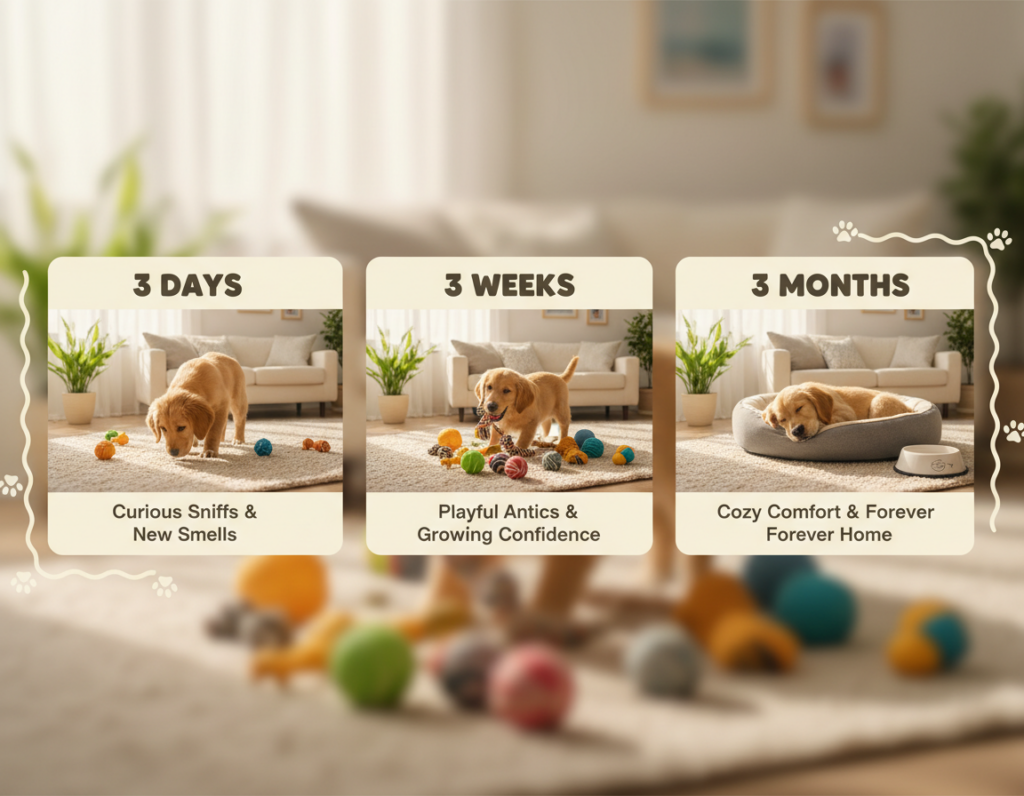
Patterns of calm and testing usually emerge at roughly three-day, three-week, and three-month marks. Use this Rule of 3’s as a guide to set realistic expectations for behavior and progress during the transition.
What to expect in the first few days
In the first few days expect decompression and cautious exploration. Some dogs withdraw and eat less, while others seem overly excited from stress.
Watch energy levels, eating, and toileting. Short, calm sessions and steady routine reduce anxiety and prevent overwhelm.
What often changes by three weeks
By about three weeks the routine usually begins to click. Dogs start to show more of their normal temperament and may test boundaries as they gain confidence.
Training responses often improve and accidents tend to drop with consistent cues and management.
What full acclimation can look like by three months
At three months many dogs sleep more predictably, respond reliably to cues, and handle house sounds better. Fewer accidents and steadier energy are common signs of acclimation.
Some animals need longer. Major life changes, multiple rehomes, or higher baseline anxiety can stretch this period. Patience and steady routine prevent setbacks.
| Timepoint | Typical signs | What to do |
|---|---|---|
| First 3 days | Decompression, cautious or hyper behavior, possible low appetite | Keep areas small, feed predictably, offer quiet rest |
| ~3 weeks | Routine forms, testing boundaries, emerging personality | Increase gentle training, reinforce calm behavior, keep consistent cues |
| ~3 months | More steady sleep, fewer accidents, smoother responses | Expand spaces slowly, maintain routine, monitor confidence |
| Longer term | Slower progress with high anxiety or big changes | Consult trainer or vet, use gradual desensitization |
“Look for practical benchmarks—choosing a bed, easier crate time, and calm exploration—rather than a firm deadline.”
Prevent Setbacks: Alone Time, Visitors, and Introducing Other Pets
Use controlled, stepwise absences so the dog learns calm during short departures. Start with minutes and build over days and weeks. Many dogs should not be left alone in a new home for at least 1–2 weeks; consider a pet sitter or bringing the pet along when practical.
Alone-time plan that works
Schedule first departures during a normal nap. Leave for a few minutes, return calmly, then extend to 15, 30, and 60 minutes across several weeks.
Keep departures predictable: use the same routine, crate or quiet space, and a short comfort toy so separations become ordinary.
Visitors and family routines
Delay big gatherings until the dog has settled over several weeks. Too many people at once can flood senses and slow progress.
Make sure every household member knows the routine: consistent cues, calm voices, and no grabbing while the dog rests.
Introducing resident dogs and cats
For dogs, favor neutral meetups and parallel leash walks, then supervised settling at home. Feed separately, remove high-value things, and separate dogs when unattended.
For cats, practice crate and room confinement for the dog, create a dog-free cat room, and start interactions through a baby gate. Train calm settling when the cat moves; high prey-drive dogs may need professional help and may never be safe with cats.
Practical tip: If things get tense, pause introductions and return to short, supervised sessions until calm behavior and basic training are reliable.
Conclusion
Wrap up with a clear plan that keeps routine simple, predictable, and gentle as confidence grows.
Keep the environment small at first, build a safe den, and expand access slowly as the dog shows calm trust. Use reward-based training and gentle redirection to teach house rules without fear.
Expect progress over days, weeks, and months; each dog moves at its own pace. Stay vigilant: supervise, redirect chewing, and schedule proactive potty trips to prevent setbacks.
Health note: contact a veterinarian if the new puppy refuses food, has ongoing diarrhea, shows extreme panic, or repeatedly tries to escape.
Track what works—sleep spot, toys, and best potty timing—and revisit routines as the pet settles into the new home.