Understanding the behavior helps owners stay safe and calm. Pet protection over possessions happens when an animal thinks a valued item might be taken. That response can be a soft warning like a look or a harsher signal such as growling or lunging.
It is normal in wild and domestic species as a way to protect food and playthings. It becomes a problem when it raises the risk of injury, stress, or harms relationships at home.
This short guide previews common triggers and early signs, causes, safe at-home management, clear “do-not-do” steps, and positive training plans to lower risk. We explain behavior so it can be addressed; explanation is not the same as excuse.
If a pet has bitten or is escalating fast, prioritize safety and seek professional help rather than confronting the issue alone. Many owners feel shocked when protecting appears suddenly; practical steps and pattern-spotting can reduce chances of aggression around food, toys, and other household items.
What Resource Guarding Means for Dogs and Owners Today
Modern pet professionals favor terms that describe behavior, not blame. Many prefer the phrase resource guarding over older labels because it explains motivation and avoids calling an animal “bad.” Clear language helps an owner act safely and calmly.
“Any behavior that discourages another to take, or get too close to, an object or valued area in the dog’s possession.”
How guarding can escalate: subtle warnings — stiffening, hard stares, or lip lifts — can become louder when ignored or punished. Stress, repeated conflict, or the belief that aggression works can push behavior toward growling or lunging.
Why it still happens: domestication did not erase instincts to protect food, safe space, and cherished items. Animals react to perceived threat, not a human’s intention.
- It matters because it affects feeding, toy pickup, shared furniture, and guests.
- Early signs resource guarding include stiff posture, direct eye contact, and warning growls.
Later sections offer step-by-step ways to reduce risk with humane training and better routines.
Common Triggers: Food, Toys, Space, and High-Value Items
Triggers for resource guarding vary widely. Some are obvious, like bowls and chews. Others are surprising, such as a favored spot in the kitchen or a stolen sock.
Food aggression: bowls, treats, bones, and edible chews
Edible resources carry high value. A full bowl, a long-lasting chew, or a single treat can spark protective responses.
Typical bowl triggers include approaching, reaching down, adding food, or removing the bowl. Even an empty bowl can be prized after meals.
Non-food resources: toys, “contraband,” and household items
Toys and stolen contraband — tissues, socks, or shoes — can become prized items. When people chase or make a fuss, the item gains extra value.
Location guarding: beds, crates, couches, and feeding areas
A favorite bed, crate, or doorway can become a defended place. Blocking access or hovering near that spot often escalates tension.
Guarding people: when dogs treat a human as a resource
Some dogs defend a person, especially when food or toys are present. This sometimes overlaps with leash reactivity or fear-based aggression; a professional can sort the cause.
| Trigger Type | Common Examples | Why It Matters |
|---|---|---|
| Food | Bowls, treats, bones, chews | High innate value; short-term possession |
| Objects | Toys, socks, napkins | Human attention can inflate value |
| Place/Person | Beds, couches, a favored human | Access control causes conflict |
Odd example: some pets defend a dishwasher area or an open pantry corner. This shows how a “resource” can be almost anything.
Signs Resource Guarding Is Developing (Before a Bite Happens)
Many problems start quietly. Small shifts in posture, pace, or gaze often come before louder warnings. Spotting these early signs gives people time to act and reduce risk.
Subtle body language owners often miss:
- Freezing or sudden stillness when approached.
- Eating faster or shifting to block a bowl or chew.
- Braced, low body over an item or placing a paw on it.
- Side-eye or “whale eye,” lip lifts, pinned ears, and a hard stare.
These quiet behaviors matter because they are communication. If ignored, the animal rehearses that escalation works, which raises bite risk over time.
Clear warning signs
When signals step up, the behaviors become unmistakable: low growls, teeth baring, lunging, air snapping (a no-contact bite), chasing someone away, and actual biting.
Mealtime and toy examples: At meals a pet may suddenly eat faster, stop and stare, or shift to block the bowl when people pass. With toys, the animal may grab and move away, cover the item with a paw, turn its head, or track people with a fixed stare.
Safety note for families and visitors: If you see any of these signs around children or guests, create distance immediately. Use gates, closed doors, or pick the person up and out of the area—do not try to remove the item or force contact in the moment.
Remember: these signs show a fear of loss, not dominance. Treating them as communication lets you use positive strategies later to reduce escalation and keep everyone safe.
| Stage | Typical Signals | Recommended Immediate Action |
|---|---|---|
| Subtle | Freezing, faster eating, paw on item, side-eye | Give space, avoid reaching, note context for training |
| Elevated | Lip lift, pinned ears, hard stare, blocking body | Increase distance, use barriers, record behavior for trainer |
| Overt | Growling, lunging, air snaps, biting | Prioritize safety, stop training, seek professional help |
Why Dogs Start Guarding: Causes and Risk Factors
When an animal starts guarding, the cause is rarely a single event; several risk factors usually interact. Understanding these drivers helps an owner reduce risk and plan safer management and training.
Fear, anxiety, and learned history
Fear and anxiety are central. Many dogs guard because they fear losing valued items. If an item was taken before with no trade, the pet learns loss is likely and becomes defensive.
Learning history matters: if a growl made people back away, the behavior was rewarded. If humans grabbed items, the animal learns people predict loss.
Home stressors that increase risk
Changes in the environment raise tension. Guests, a new baby, a new dog, renovations, or loud events can push a sensitive animal to protect items more often.
Competition, genetics, and temperament
Limited resources — one chew for two dogs or a crowded feeding area — can inflate conflict, especially in multi-pet homes and litters. Genetics and individual temperament also matter; some animals are simply more prone to possessive behaviors.
Medical issues to rule out
Sudden changes in behavior can signal pain or illness. Arthritis, dental disease, or other medical issues can make a pet irritable and more likely to guard. A vet exam is essential when guarding appears quickly.
Varied cases and next steps
Cases vary in severity. Some dogs need simple management changes; others require professional behavior support. The following sections explain home management and positive training strategies to lower risk over time.
Dog Resource Guarding Safety and Management at Home
Managing the environment is the first step to reduce incidents and keep everyone safe. Thoughtful changes prevent rehearsals of guarding and give training time to work without risk.
Practical home checklist: pick up food bowls between meals, avoid free-feeding, store high-value chews and toys out of reach, and secure laundry or small items that trigger interest.
Barriers and private spaces
Use baby gates, closed doors, crates, or exercise pens so the dog can eat and chew in peace. Barriers stop accidental approaches and reduce conflict during meals or chew time.
Multi-pet rules and family routines
Feed dogs separately and never leave loose chews on the floor. Teach kids and adults not to approach or pet while a pet eats or chews. A consistent family plan ensures everyone responds the same way.
Handling stolen items safely
Don’t chase. Calmly create distance, use a cue to call the pet away if trained, or trade for a better treat to recover the item. This protects people and prevents the behavior from being rewarded by chasing.
“Management is not giving in — it is risk reduction so training can proceed safely.”
When to escalate: if guarding is frequent, unpredictable, or has led to biting, implement strict management immediately and seek a certified trainer or behaviorist before attempting more hands-on work.
What Not to Do When You See Guarding Behavior
An animal’s warning is useful information; handling it poorly can make the problem worse.
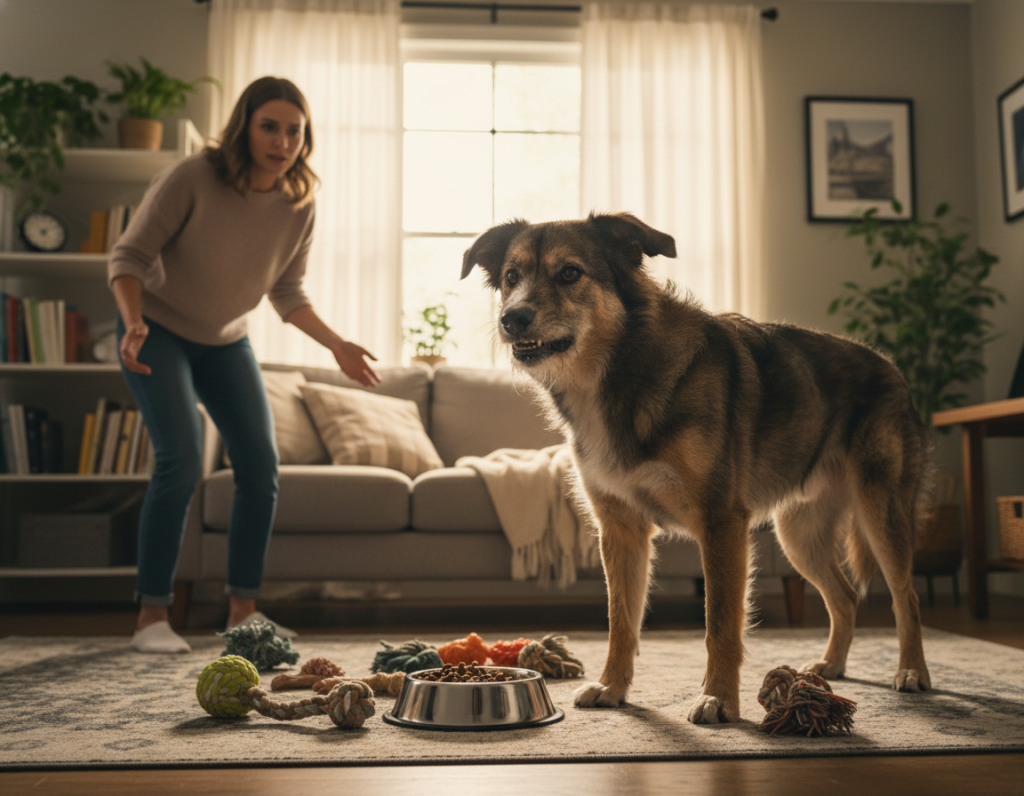
Do not punish a growl. A growl warns people to back off. If owners suppress that warning with yelling, hitting, or harsh corrections, the pet may stop signaling. That seems good at first, but it raises the chance of a sudden snap or bite later.
Why punishing the growl makes aggression worse
Punishment does not remove the feeling of threat. It teaches the animal that showing discomfort is dangerous. The next time the pet feels at risk, it may skip warnings and move directly to aggressive behavior.
Why “testing” by touching the bowl or taking chews backfires
Sticking hands into a bowl or yanking a chew teaches a clear rule: humans equal loss. Over time, people become the signal to protect food or toys.
That pattern increases tension and makes aggregation of aggressive responses more likely. Testing is especially risky around children or guests who may misread signals or react unpredictably.
- Safer mindset: change the pattern so human approach predicts good things, not loss.
- Practical step: manage distances, secure items, and avoid surprise reaches.
- Training note: begin under threshold with positive methods that pair approach with treats.
Management first, then training: safety measures give time for structured, positive work that prevents escalation.
| Wrong Action | Why It Hurts | Safer Alternative |
|---|---|---|
| Punishing a growl | Removes warning; raises bite risk | Give space; record behavior for trainer |
| Touching bowl/stealing chew to “test” | Teaches human approach = loss | Trade for a treat; make approach predict rewards |
| Yelling, intimidation, physical correction | Increases fear and escalation | Use barriers and calm routines; seek positive training |
Training to Reduce Resource Guarding Using Positive Methods
The goal of training is to make human presence predict good things, not threats.
Start with distance. Tether the pet safely and begin about 6–8 feet away. Walk by while tossing high-value treats, then step back. If any warning signs appear you are too close; increase distance and repeat.
Counterconditioning mechanics: pair each approach with a tasty reward and a retreat. Over time, people near items become a cue for treats rather than loss.
Teach a reliable trade game
Offer something better, use a release cue if known, reward, and then—when safe—allow the pet to return to the original item. Repeat this so exchange becomes trustworthy.
Build foundation cues
Work on “Drop It” for releases, “Leave It” for disengagement, and “Go to Bed” to create predictable space. Reinforce these with many short, positive reps.
Session setup and safety
- Keep sessions short (5–10 reps), low distraction, and controlled.
- Stop before any growling or lunging so the animal never rehearses escalation.
- Use barriers and consistent household rules during practice.
When to pause: if the behavior is intense, the pet has bitten, or the home cannot control variables, shift to strict management and consult a qualified professional. For step-by-step help, see this training guide.
Resource Guarding Between Dogs (and Other Pets) in the Same Home
When more than one animal lives together, tensions around prized items are common. Shared bowls, long chews, prime couch spots, or a favored bed can trigger conflict between pets.
Ritualized aggression vs. true fighting
Ritualized aggression looks loud—posturing, staring, and short growls—but often serves as communication and stops before contact.
True fighting includes biting, sustained attacks, or injuries. That level raises immediate safety concerns for all animals and household members.
Relationship-building without triggering resources
Work on shared routines that avoid contested items. Try parallel walks, separate short training sessions with treats, and calm co-existence time with no chews on the floor.
When to bring in a certified trainer or veterinary behaviorist
Call a pro if incidents repeat, if any pet is injured, or if triggers are unpredictable. New additions—puppies, a recently adopted shelter animal, or schedule changes—often increase cases and need early planning.
| Sign | What It Looks Like | Immediate Action |
|---|---|---|
| Ritualized | Stiff stance, growl, posturing, no contact | Separate briefly, supervise, plan training |
| True fight | Biting, repeated contact, wounds | Prioritize safety, vet check, seek certified help |
| High-value trigger | Chews, special toys, favored place | Feed separately, remove shared items, supervise |
Example: two dogs may tolerate kibble but fight over a long chew. Preventing those triggers and using targeted, professional plans keeps the whole family safer. For more guidance, see this resource on resource guarding.
Conclusion
Recognizing early signs and acting calmly is the fastest way to keep everyone safe and reduce escalation.
Resource guarding is a common aspect of dog behavior. It often stems from a belief that food, toys, or certain items may be lost. Noticing subtle signs gives you time to respond safely.
Use barriers, separate feeding, and clear household routines to prevent rehearsals. Do not punish growling, and do not test by grabbing bowls or chews—those moves usually make the problem worse.
Follow a training roadmap: distance-based desensitization, counterconditioning, and a reliable trade game with cues like Drop It and Leave It. If a pet bites, lunges frequently, or is unpredictable, consult a certified trainer or veterinary behaviorist and consider a vet exam for sudden change.
With careful management and positive training, many dogs learn that people near their resources is safe.